A workflow comparison
Pinterest Alternatives for Designers by Workflow.
For discovery and connected research, start with Are.na. For a reusable asset library, compare Eagle, mymind and Linger. For a board you can reopen and export, look at PureRef.
We make Linger. Personal and Lifetime licenses are available to purchase for macOS, with software access expected by email October 8–15, 2026. Competitor capabilities below are based on official documentation; our worked Linger example uses synthetic demo data.
START WITH THE JOB
What do you want to replace?
- Finding work you have not seen. Look for a discovery network. Are.na connects content through people and channels; Pinterest may still be useful for browsing while another tool holds your chosen references.
- Finding something you saved months ago. Look for source retention, useful notes, search and a library you can reuse across projects. Compare Eagle’s asset organization, mymind’s automatic organization, and Linger’s local library with your own words.
- Arranging a board for one brief. Look for saved layouts and a usable export. PureRef documents scene saving and image export. A long-term reference library and a finished project board can be different tools.
THE SHORTLIST
Five tools, different jobs.
| Tool | Job to consider it for | What to check before choosing |
|---|---|---|
| Are.na | Discovering and connecting research | Channel visibility, collaboration and export fit your workflow. |
| Eagle | A reusable design-asset library | Capture, tags, filters and your file formats. |
| mymind | Private saving with automatic organization | Search quality for your saves and the plan’s device/export coverage. |
| PureRef | A saved reference board beside your work | Reopening the scene and the exported image you need to deliver. |
| Linger | A local Mac library with personal notes | One-time purchase ($39 / $79); downloads expected Oct 8–15, 2026; separate local libraries. |
Are.na: connected research and discovery.
Are.na’s official overview describes saving images, text, files and webpages into channels, then connecting existing content into new contexts. Channels can be open, closed or private; channel exports include PDF, ZIP and HTML. Consider it when discovering connections and sharing research matter. Check visibility before uploading private references. Its overview lists a free Guest tier and paid membership options. Official features and plans.
Eagle: a design-asset library.
Eagle documents browser capture, tags, filters, annotations and support for many design file formats. Its store lists a one-time license for two devices, with macOS and Windows support. Consider it if you need substantial asset organization as well as inspiration collecting. Test the specific formats, source links and searches you use. Official features · License and current price.
Choose the library branch when the file must remain useful after a project ends. Eagle’s organizing guide demonstrates keeping a reference’s reason, tags and URL together, then retrieving it for another brief. That is a closer match to an existing design-asset archive than choosing a tool mainly for a feed. It does not by itself establish a shared client-review or final-delivery workflow; test those separately if you need them.
Already have an Eagle library? Use the Eagle-or-Linger decision guide to check whether switching solves a real problem and what context a sample transfer must retain.
mymind: private saving with automatic organization.
mymind describes automatic organization, search by visual and textual clues, notes, article saving and Smart Spaces, with content synced across devices. Consider it when you want to spend less time manually filing each save. Check the plan you would use and test its search against your own references. Official product overview.
PureRef: the project board.
PureRef’s current handbook documents local .pur scenes, notes and groups. You can save a scene, reopen it, and export the canvas or selected images. Consider it for a working arrangement beside your design application or an image you need to deliver. Evaluate the board workflow separately from long-term library search. Saving and export · Notes and groups · Download and purchase options.
Linger: a local library with your own clues.
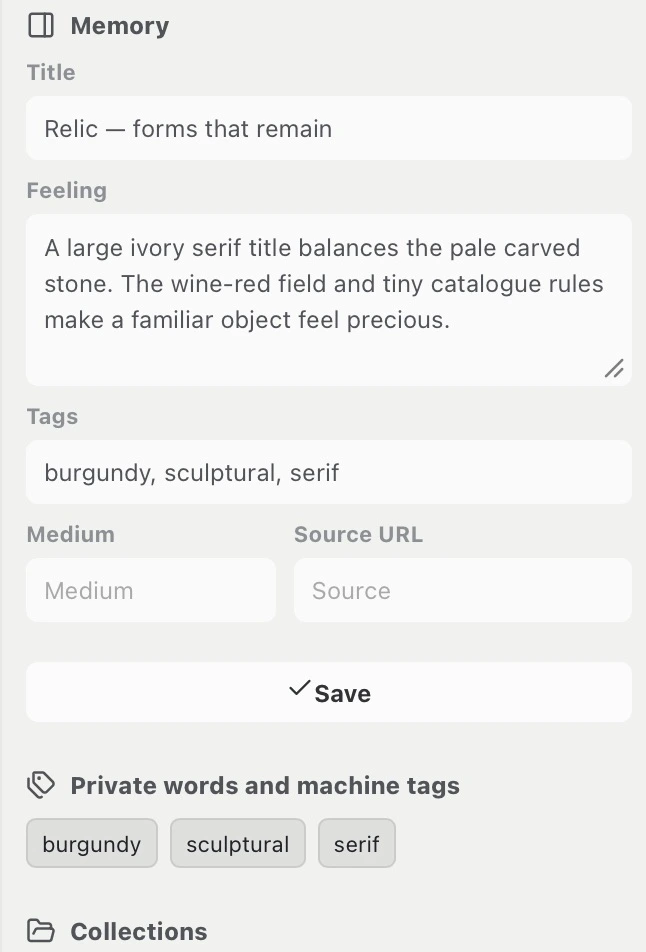
Linger keeps imported copies, personal reasons, tags and source information in a managed local library. Keyword Recall searches saved fields and can narrow by source, media and date. Saved queries become dynamic collections. Optional model tasks use your own API or an external agent through MCP and are off by default.
Personal ($39) and Lifetime ($79) licenses are available to buy for macOS, with software access expected by email October 8–15, 2026. Device allowances depend on the license; each Mac keeps its own local library. The current Canvas is temporary, and there is no built-in cloud sync or automatic Pinterest-board migration. If you need a shared team board or a saved deliverable, choose an available tool that covers that job. Compare current plans.
A SMALL WORKED EXAMPLE
Can you find the same reference for a second brief?
Compare one reference, not feature counts. Start with a file you can use publicly, one source link and one sentence explaining why you saved it. A useful candidate should preserve the parts your work depends on.
Use the same task in the candidates you can try: keep one reference, its source and your reason; leave it; find it from a remembered clue; then use it to answer a different brief. The Relic walkthrough supplies the same generated artwork, saved note and query results throughout. If you use your own image, keep that image unchanged across trials.
| Task | What to try | What counts as useful |
|---|---|---|
| Preserve the source | Save the original page beside a web image, or record that your sample is self-made. | Later you can distinguish the creator’s page from an image-host URL. Relic has no original web page. |
| Keep a personal reason | Save the Relic note and burgundy, sculptural, serif; leave the item and return. | The same item still holds the reason and cues you chose. |
| Retrieve a known clue | Search catalogue from the saved note, then sculptural. | You find that reference without remembering its folder. Record how many other candidates appear. |
| Handle a missing clue | Try nostalgic before and after adding it to the note. | Record the actual outcome. Do not assume every tool uses keyword matching or handles synonyms the same way. |
| Use it for a second brief | Move from a gallery identity to a museum catalogue cover; preserve the original observation. | You can explain what transfers and keep the reference’s source and context. |
| Deliver a board, if needed | Save the arrangement, quit, reopen and export it. | The layout survives and the exported file meets the brief. A library search alone does not pass this task. |
In our October 7 desktop walkthrough, we imported one image into the installed Linger 0.3.1 app and saved its note and tags. catalogue found Relic. nostalgic returned no results until we added it to the note and selected Save; Relic then returned, including after quitting and reopening the app. The results table records this one-image run.
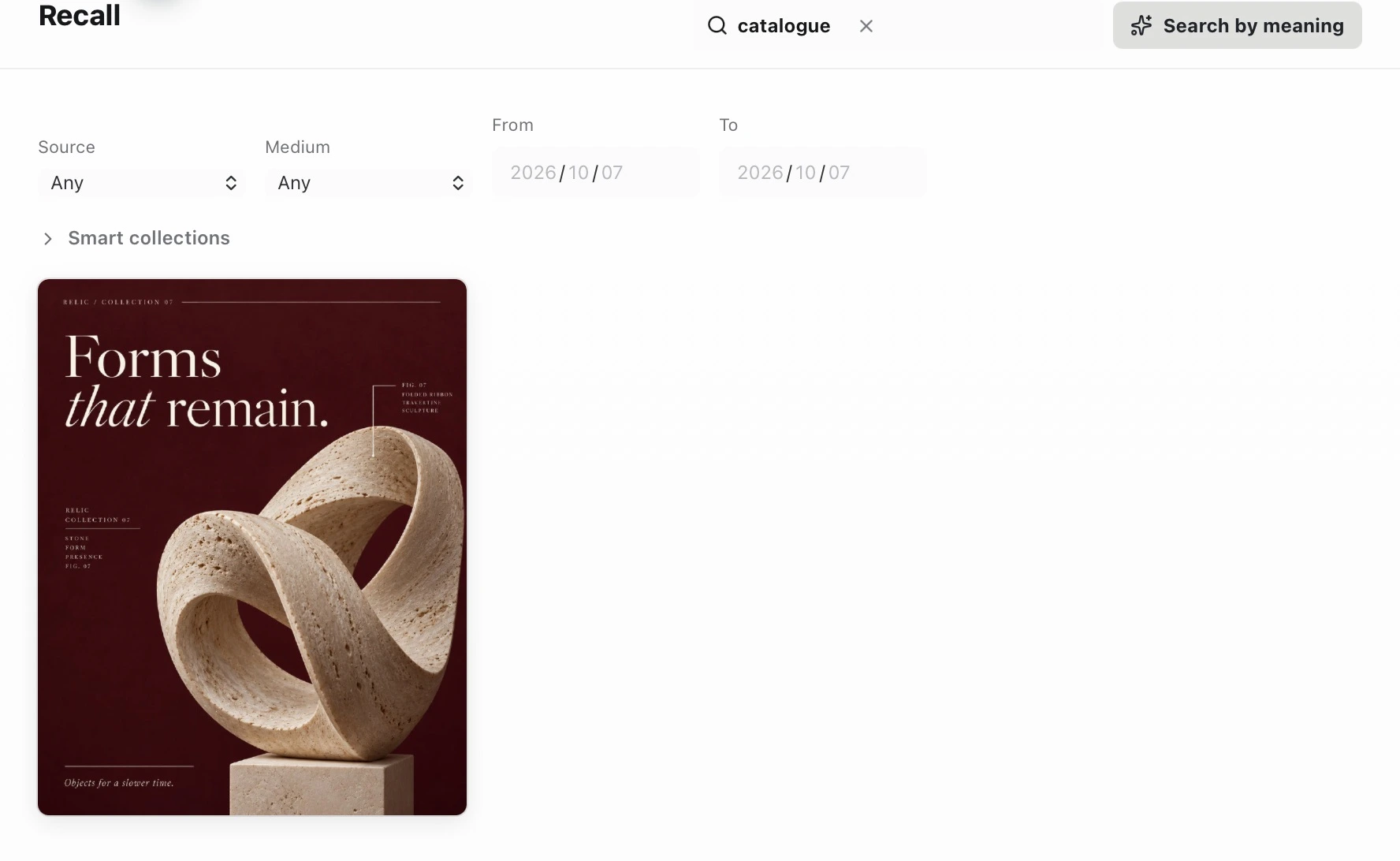
We have not run this task in the other four products. Their entries above are documented capability checks. Use the same images and questions in your own trial before deciding which workflow fits.
Let the result decide what to adopt.
If finding unfamiliar work is the main job, start with a discovery tool such as Are.na and keep Pinterest if it still helps. If your own saved files are the bottleneck, trial Eagle with your actual file types, or mymind if its documented automatic organization and cross-device workflow appeal to you. If the deliverable is a board you must reopen and export, start with PureRef’s scene workflow.
Consider Linger’s workflow if you want a local Mac reference library and prefer recording your own clues. Pre-orders have ended; you can review the product while the public release is being prepared. It is a poor match when you need an immediate download, built-in cloud sync or a persistent Canvas today. None of these tools has to replace every part of Pinterest: discovery, long-term storage and a project board can remain separate.
Before paying, check the vendor’s current plan, device support and trial or purchase terms. The linked official pages describe capabilities; they are not proof that your particular sources, searches or exports will work as expected.
BEFORE YOU MOVE
Keep the source as well as the picture.
Pinterest’s official help explains downloading individual image Pins where that option is available; not every Pin can be downloaded. Saving a Pin to a Pinterest board and downloading its image are different actions. Pinterest’s download instructions.
Do not assume an image download carries its original webpage, creator, captions or board structure. Try a small migration first, preserve the Pin and original page links you know, and inspect the result in the destination. Linger currently imports local files and saves supported links; it does not automatically migrate Pinterest boards.
Use the source-record guide to keep the original page, media link and confirmed credit separate.
COMMON QUESTIONS
Choose for the way you work.
Which alternative is best for a private reference library?
Compare the workflow you want: Eagle for asset organization, mymind for its documented automatic organization and cross-device collection, or Linger for a local Mac library with personal notes. Linger offers one-time macOS licenses ($39 / $79), with software access expected by email October 8–15, 2026. Try your own source and retrieval task in any available candidate.
Which tool helps me discover new images?
Are.na documents discovery through people and connected channels. Pinterest can remain your discovery source while a separate tool stores the references you decide to keep. A local library does not need to replace the discovery feed.
Can I import my Pinterest boards?
There is no automatic board-import workflow in Linger. Pinterest documents individual image downloads where available. Check each destination’s official importer and test what happens to source links and notes before moving a large collection.
Which features work offline?
Linger’s local browsing, notes and keyword search use the local library; remote model calls and online sources require a connection. PureRef documents local scene files. For each tool, separately test local browsing, search, media, activation and export offline; cloud sync and an offline collection are different requirements.
Can I use Linger as a permanent mood board?
The current Canvas does not preserve its arrangement after you quit. For a board you must reopen or export, use a tool with a documented saved-scene workflow, such as PureRef.